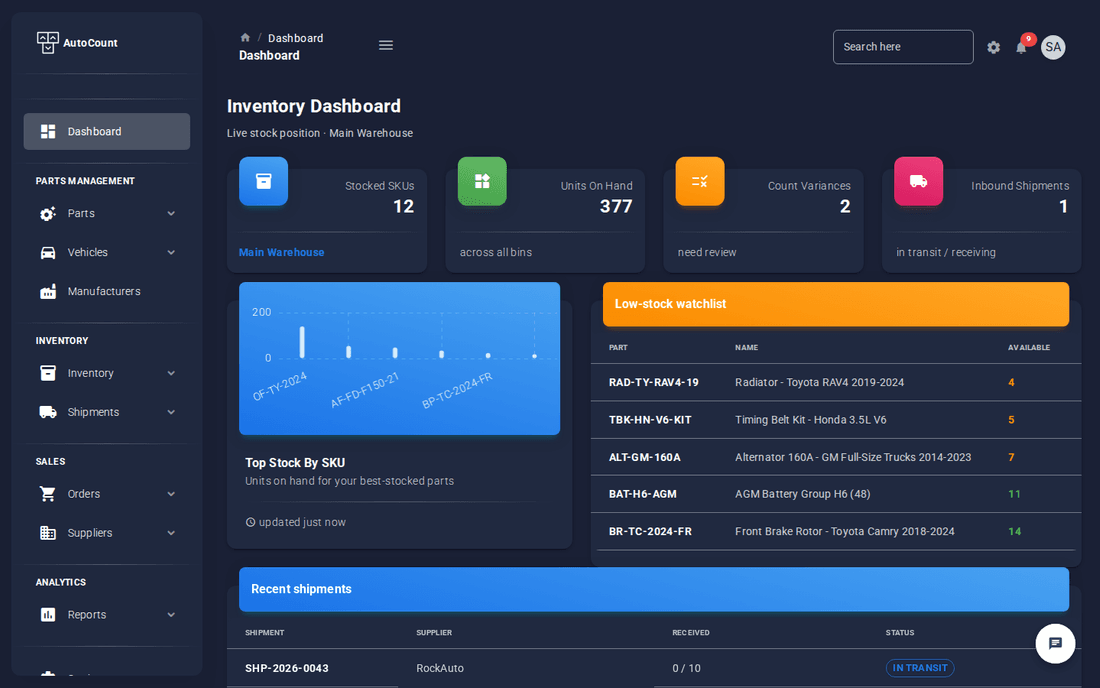
A regional auto-parts distributor was running inventory on a spreadsheet that was always days behind the shelf. We replaced it with AutoCount: scan-in, scan-out, live counts and low-stock alerts at the counter.
The distributor moves thousands of SKUs across a busy counter and a back warehouse. Inventory lived in a spreadsheet — updated by hand, usually at the end of a shift, and only by whoever remembered. By the time a count was typed in, the shelf had already moved on.
That gap costs money in two directions at once. Fast-moving parts hit zero without warning, so a customer at the counter got "we'll have to order that in" — and often went down the road instead. Meanwhile slow movers quietly piled up in the back, tying up cash in stock nobody was tracking. Nobody trusted the number in the spreadsheet, so staff walked the aisles to check — which is exactly the manual work the spreadsheet was supposed to remove.
These are the classic inventory mistakes: no real-time count, no reorder trigger, and a single fragile file standing in for a system.
Parts are scanned as they arrive and as they sell. The count changes at the moment stock moves — not hours later when someone updates a file.
Staff at the counter can look up any part and see a number they can trust, instantly — no walking the aisle to double-check.
When a fast mover drops below its threshold, AutoCount flags it — so reordering happens before the shelf is empty, not after a lost sale.
Everyone reads and writes the same live inventory instead of passing around a spreadsheet that only one person can safely edit.
The workflow is shaped around how a parts business actually runs — quick scans, quick lookups, minimal typing during a rush.
Deployed under the distributor's brand, with the inventory data theirs to keep — a system they own, not a subscription that owns their stock.
The core change is trust: the number on the screen now matches the shelf, because it updates the instant a part is scanned. That single shift removes the guesswork behind every other decision — what to reorder, what's overstocked, whether to promise a customer a part is in.
Low-stock alerts turn reordering from a reactive scramble into a routine: fast movers get topped up before they run out, so the counter says "yes, we have it" more often. And because everyone works from the same live count, staff stop walking the aisles to verify a spreadsheet they didn't believe.
What we won't claim: we're not publishing the distributor's stock value, sales or shrinkage figures — those are theirs, and this write-up is anonymized at their request. The honest, structural win is that a fragile end-of-day spreadsheet became a live system the whole counter can trust.
Book a free 15-minute strategy call. We'll look at how you track stock today and show you what a live, barcode-driven system would change — honestly, including whether it's worth it yet.